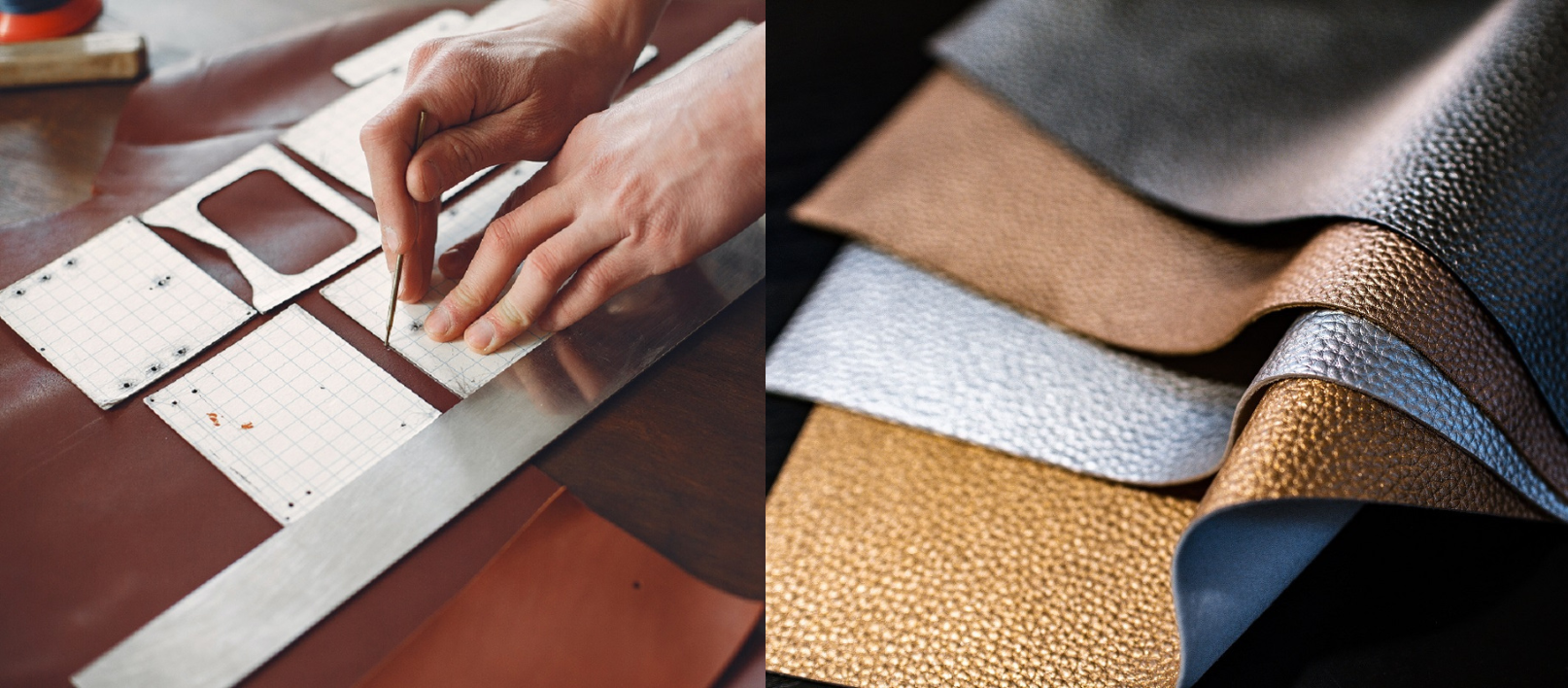
Leather goods is much more than the manufacture of leather goods.
It is a technical discipline that combines tradition, knowledge of materials and process control to respond to real brand and product needs.
In the business environment, the difference between standard leather goods and professional leather goods is decisive.
This article analyzes what truly defines a business-oriented leather goods company, what factors define quality and how to turn leather work into a strategic positioning tool.
What is leather goods and why is it still strategic for companies?
Leatherwork was born as an artisan craft linked to the manual work of leather.
To understand its evolution into a structured business environment, it is important to first understand what leather goods is and how it has evolved from a traditional craft into a specialized production system.
Historically, the leather worker selected the material, cut it, sewed it and transformed it into functional objects: bags, wallets, cases or travel accessories.
As time went by, this trade evolved.
The demand for quality, the need for homogeneity in larger series and the incorporation of new production techniques transformed leather goods into a specialized industrial system.
Today, in the professional field, leather goods play a strategic role for companies:
- Reinforces brand perception.
- Provides tangible value to products and services.
- It allows the development of its own lines with a differentiated identity.
- Generates coherence between design, material and positioning.
In sectors such as fashion, corporate equipment, hospitality or premium corporate gifts, leather remains a symbol of permanence and quality.
It is not only the material that is relevant.
It is the ability to transform it with technical criteria, productive consistency and entrepreneurial vision.
Professional leather goods, therefore, is not limited to the manufacture of parts.
It becomes a strategic partner capable of translating a brand idea into an object that is durable, functional and consistent with the company’s positioning.

Types of leather goods in the professional field
Not all leather not all leather goods the same production model and the same level of exigency.
For a company looking to develop leather products, understanding these differences is critical before choosing a supplier.
In the professional environment we can distinguish three main approaches.
Traditional handcrafted leather goods
It is the form most closely linked to the origin of the trade.
It is characterized by:
- Manual production.
- Very limited series.
- High individual component in each piece.
- Direct dependence on the artisan.
This model provides cultural value and uniqueness, but often has limitations when the project requires scalability, repeatability or control of homogeneous standards.
For structured business projects, pure craftsmanship may be insufficient if it is not supported by defined technical processes.
Specialized industrial leather goods
It is the natural evolution of the trade into a professional and entrepreneurial environment.
Here tradition coexists with:
- Structured production processes.
- Quality control at each stage.
- Production capacity in medium and large series.
- Traceability of materials.
- Time and cost optimization.
Specialized industrial leather goods manufacturing does not eliminate artisanal know-how. It systematizes it.
It allows each piece to maintain aesthetic and technical coherence within a given volume, which is essential for brands, distributors and corporate companies.
This model provides stability and reliability in the B2B environment.
Corporate leather goods and custom development
There is a third approach specifically oriented to the business world.
The objective here is not to manufacture a standard catalog, but to develop a product adapted to the customer’s needs:
- Brand identity.
- Specific functional needs.
- Integration with packaging and communication.
- Customization requirements.
This type of leather goods requires:
- Technical design capabilities.
- Prototype development.
- Fine adjustment of finishes.
- Flexibility in short and medium series.
It’s not just about manufacturing. It’s about interpreting a brand strategy and turning it into an object.
Understanding these typologies allows a company to make more informed choices and avoid common mistakes when looking for a supplier.
In the next section we analyze the key criteria for evaluating a professional leather goods store from a technical and strategic perspective.

Key criteria for evaluating a professional leather goods store
Choosing a leather goods store should not be based solely on catalog or unit price.
In the B2B environment, the decision affects positioning, brand consistency and reputation.
These are the factors that really differentiate a professional supplier.
Skin selection and treatment
The final quality of a part begins long before cutting.
A professional leather shop works with clear criteria in the selection of leather:
- Type of tanning (vegetable or chrome, according to use and required finish).
- Thickness and structure appropriate to the functionality of the product.
- Uniformity of color and texture.
- Control of natural imperfections.
Leather is not a homogeneous material. It requires technical knowledge to take advantage of its qualities without compromising strength or aesthetics.
A serious supplier must be able to explain what material is used and why.
Production processes and internal control
Leather work requires precision.
Cutting, die-cutting, routing, gluing, sewing and assembly must be structured within a defined production flow. Knowing how to sew is not enough. It is necessary to control tolerances, finishing and strength.
Aspects to be evaluated:
- Existence of quality control protocols.
- Inspection of parts prior to shipment.
- Homogeneity in medium and long series.
- Stability of finishes.
Consistency is one of the greatest indicators of professionalism.
Custom development capability
In corporate or branding projects, the standard product is rarely enough.
A professional leather goods store must offer:
- Prototype development.
- Adjustment of measures and structures.
- Elegant visual identity integration.
- Adaptation to specific end-customer requirements.
The ability to transform an idea into a technically viable product is a clear differential.
Reliability in terms of deadlines and volume
In the business environment, missed deadlines have a direct impact on campaigns, launches and commercial commitments.
It is therefore essential to evaluate:
- Real productive capacity.
- Structured planning.
- Previous experience in similar projects.
- Transparency in delivery times.
Professional leather goods not only manufactures well. It delivers.
When these criteria are rigorously analyzed, the choice is no longer intuitive but strategic.
In the next section, we will make a direct comparison between standard leather goods and premium leather goods, to understand what really differentiates one from the other.
Differences between standard leather goods and premium leather goods
In the market there are multiple offers under the term leather goods.
However, not all respond to the same level of demand. For a company seeking brand consistency and production stability, understanding this difference is key.
Here is a clear comparison between a standard and a premium professional approach.
Selection of materials
Standard leather goods:
- Skin of generic origin.
- Selection based primarily on cost.
- Poor uniformity control.
Premium leather goods:
- Technical selection according to use and positioning.
- Texture, thickness and finish control.
- Traceability and consistency in line items.
The raw material conditions the subsequent result.
2. Production processes
Standard:
- Production without defined protocols.
- Variability between parts.
- Limited quality control at the end of the process.
Premium:
- Structured and repeatable processes.
- Control in each production phase.
- Defined tolerances and serial consistency.
The difference is not only in the visible finish, but also in the internal precision.
3. Development and customization
Standard:
- Surface adaptation (printed logo or basic engraving).
- Closed catalog with few variations.
Premium:
- Development from technical specifications.
- Adjustment of structure, measurements and finishes.
- Discreet and strategic integration of brand identity.
This is where a company can really differentiate itself.
4. Business approach
Standard:
- Volume and price orientation.
- Transactional relationship.
Premium:
- Value orientation and positioning.
- Medium and long term collaboration relationship.
Premium leather goods is not just manufacturing. It is technical support.
This difference directly impacts how the final brand is perceived. A leather accessory can reinforce positioning… or dilute it.
In the following section we analyze the most frequent mistakes made by companies when selecting a leather goods supplier and how to avoid them.
Common mistakes when choosing a leather goods manufacturer
Selecting a leather goods company to develop a leather product is a strategic decision. However, many companies make mistakes that directly affect the final quality, brand perception and profitability of the project.
These are the most common.
Choose only by price
The most common mistake is to compare suppliers solely on a unit cost basis.
Leather is a noble material, but also a complex one. A significant reduction in price usually involves compromises in:
- Quality of the material.
- Consistency in production.
- Product durability.
When the accessory is part of the brand identity, a bad execution can be much more expensive than a larger initial investment.
Do not validate samples or prototypes
In professional leather goods, prototyping is a key phase.
Do not validate:
- Skin type.
- Thickness.
- Finishes.
- Seams.
- Engravings.
can generate significant deviations in final production.
A serious supplier should offer pre-development and fine-tuning capabilities before scaling the project.
Failure to analyze the production process
Some companies evaluate only the visual result.
However, the real quality is in the process:
- How to cut the skin.
- How stress areas are reinforced.
- How the songs are treated.
- How serial uniformity is controlled.
Without a structured process, consistency suffers.
Failure to define technical standards from the outset
In B2B projects, clarity is essential.
Specifications such as:
- Skin type.
- Thickness.
- Exact color.
- Type of yarn.
- Level of customization.
must be defined prior to production.
Ambiguity often results in subsequent adjustments and delays.
Do not assess reliability in the medium term
A supplier can execute a first order well, but can it maintain consistency over time?
Production stability and the ability to repeat standards are essential when leather goods are part of a permanent line or collection.
Avoiding these mistakes makes it possible to transform leather goods into a strategic asset rather than a source of uncertainty.
In the following section we explain how to work correctly with professional leather goods, step by step, to maximize results and minimize risks.
How to work correctly with professional leather goods?
Once the right supplier has been chosen, the success of the project depends on how the collaboration is structured.
In professional leather goods, the method is as important as the material. A clear process avoids deviations, rework and cost overruns.
This is the recommended approach in a B2B environment.
Define clear technical specifications
Before starting production, it is imperative to make sure:
- Leather type and finish.
- Exact measurements and internal structure.
- Level of customization.
- Functional requirements (strength, intended use, volume).
- Packaging if it is part of the whole.
The more precise the initial definition, the greater the consistency in the final result.
Leatherwork does not allow for technical improvisation.
2. Develop and validate a prototype
The prototype can be tested:
- Real proportions.
- Tactile sensation.
- Rigidity or flexibility of the part.
- Quality of engraving or marking.
- Aesthetic coherence with the brand.
It is time to fine-tune details before scaling up production.
A professional leather goods company understands the prototype as a strategic part of the process, not as a formality.
3. Establish a production and quality control plan.
Once the prototype has been validated, it must be agreed upon:
- Production schedule.
- Delivery times.
- Review and control system.
- Acceptance criteria.
In corporate or collection projects, repeatability is as important as the first run.
Serial stability defines professionalism.
4. Building medium and long term relationships
Professional leather goods do not work as a one-time purchase. It works best when there is continuity.
The sustained relationship allows:
- Adjust processes.
- Optimize materials.
- Maintain consistency in future editions.
- Improve efficiency and deadlines.
At this point, the supplier ceases to be a manufacturer and becomes a technical partner.
When leather work is approached with structure, clarity and strategic vision, leather goods become a strong brand asset.
In the last block we close with a reflection on the real value of professional leather goods in business positioning.
Leather goods as a strategic branding tool
When this approach is integrated under a 360° service model in leather goodsthe result is a complete alignment between design, technical development and production.
Leather goods is not just a product category. It is a silent positioning statement.
In a business environment where differentiation is increasingly complex, materials matter.
And leather, when well worked, conveys something difficult to replicate: permanence.
A leather accessory does not compete in the realm of the ephemeral. It competes in the field of durability.
For a fashion brand, it can represent aesthetic consistency and perceived quality.
For a corporate company, it can reinforce identity and professionalism.
For a distributor, it can become a stable line with real added value.
But it all depends on how it is executed.
Professional leather goods combine:
- Technical knowledge of the material.
- Structured production processes.
- Consistent quality control.
- Capacity of development adapted to the brand.
When these elements align, the result is not just a product.
It is a tangible extension of corporate positioning.
At Global Leather Goods we understand leather goods as a technical discipline at the service of brand strategy.
We work on each project with precision in materials and processes, with the objective of developing pieces that provide coherence, durability and real value to the companies that trust us.
If you are evaluating a leather project and need a technical partner with professional development and production capabilities, we will be happy to discuss it with you.
If you are evaluating a leather project and you need a technical partner with professional development and production capabilities, you can contact our team to discuss it with you.
Because in leather goods, the difference is not only in what you see.
It’s in how it’s done.